About Sangareddy District :
Welcome to Sangareddy District
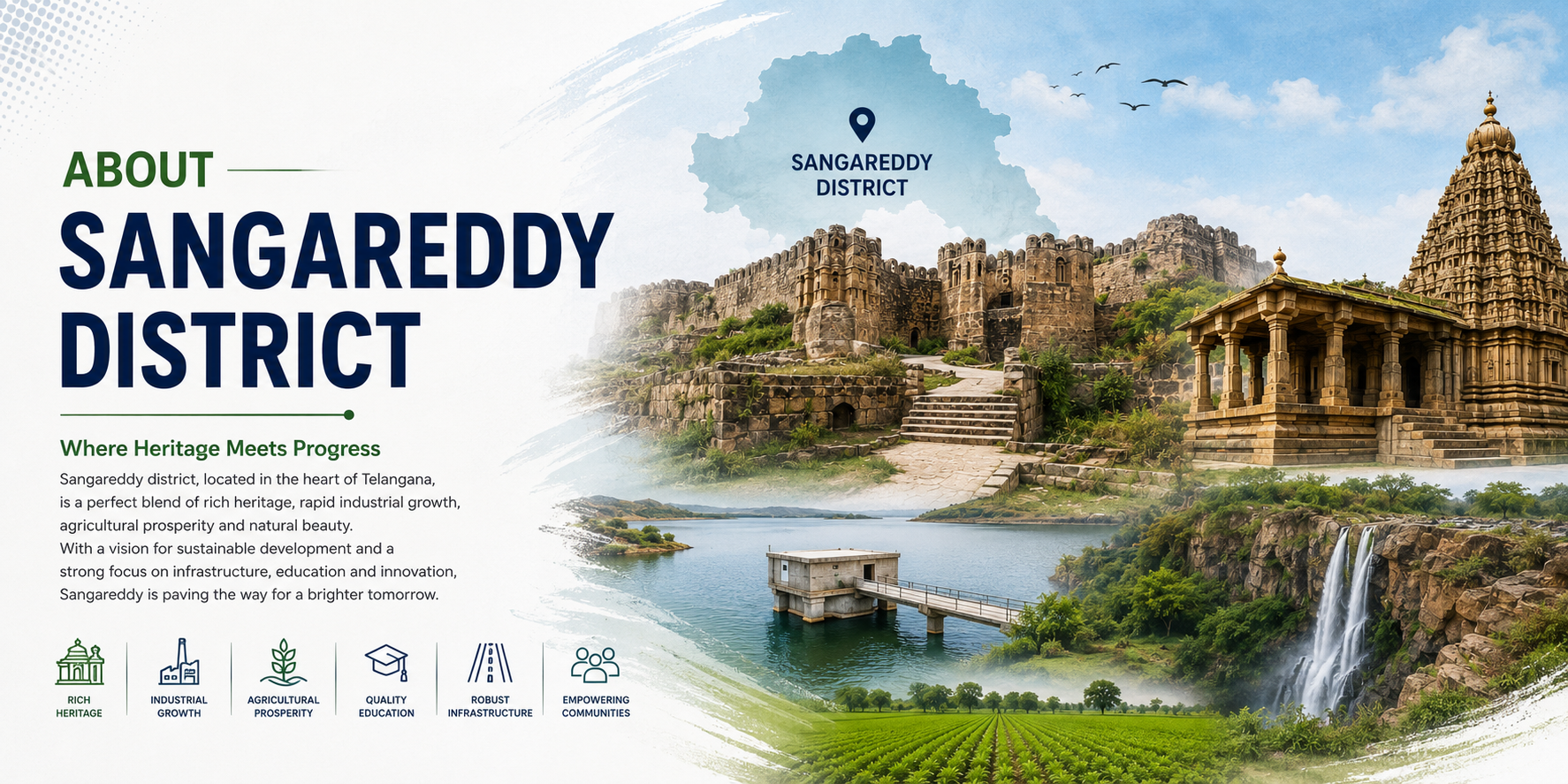
Sangareddy District is one of the prominent districts of Telangana State, known for its strong industrial base, thriving pharmaceutical sector, rich agricultural landscape, and rapid urban development. Serving as an important administrative and economic hub in western Telangana, the district has witnessed significant progress in irrigation, infrastructure, education, healthcare, and industrial growth. With a balanced mix of modern industries, fertile farmlands, and historical heritage, Sangareddy continues to play a vital role in the state’s overall economic and social development.
District Overview – Sangareddy District

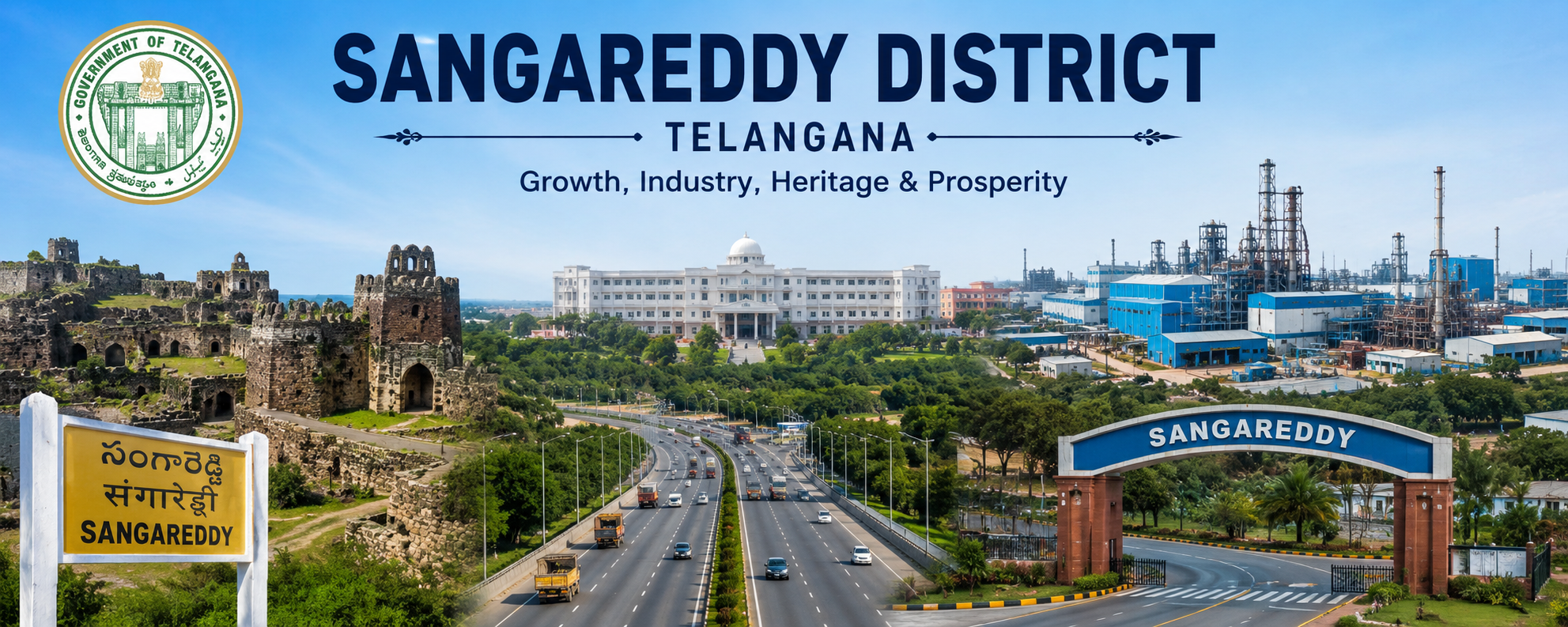
Sangareddy District is one of the most important and rapidly developing districts in Telangana State, known for its strong industrial base, fertile agricultural lands, and modern infrastructure. Formed on October 11, 2016, during the reorganization of districts in Telangana, Sangareddy has emerged as a major administrative, commercial, and economic center. The district headquarters, Sangareddy town, is located about 60 kilometers from Hyderabad, making it an attractive destination for industries, educational institutions, and residential development.
The district enjoys a unique blend of agriculture and industrial growth. Agriculture remains the primary occupation for a large section of the population, with farmers cultivating crops such as paddy, cotton, maize, soybean, red gram, sugarcane, and horticultural crops. Irrigation facilities from the Singur Reservoir, Manjeera River, and canal systems have significantly improved agricultural productivity and supported rural livelihoods.
Sangareddy is also one of Telangana’s leading industrial districts. Major industrial areas such as Patancheru, Pashamylaram, Bollaram, and Isnapur are home to hundreds of pharmaceutical, biotechnology, engineering, and manufacturing companies. The district contributes substantially to the state’s industrial output and provides employment opportunities to thousands of people from Telangana and neighboring states.
Mandal Profile of Sangareddy District
- Sangareddy
- Kondapur
- Sadasivpet
- Munipally
- Jinnaram
- Gummadidala
- Pulkal
- Andole
- Vatpally
- Jogipet
- Raikode
- Kohir
- Zaheerabad
- Nyalkal
- Mogudampally
- Jharasangam
- Kangti
- Narayankhed
- Manoor
- Kalher
- Sirgapoor
- Patancheru
- Ameenpur
- Ramachandrapuram
- Hathnoora
- Mogudampally
Population And Statistics
| Particular | Statistics |
|---|---|
| Total Population | 15,27,628 |
| Male Population | 7,77,235 |
| Female Population | 7,50,393 |
| Sex Ratio | 965 females per 1,000 males |
| Literacy Rate | 64.08% |
| Children (0–6 Years) | 1,94,674 |
| Urban Population | 5,29,965 (34.73%) |
| Rural Population | 9,97,663 (65.27%) |
| Scheduled Castes (SC) | 2,76,595 (18.13%) |
| Scheduled Tribes (ST) | 86,410 (5.66%) |
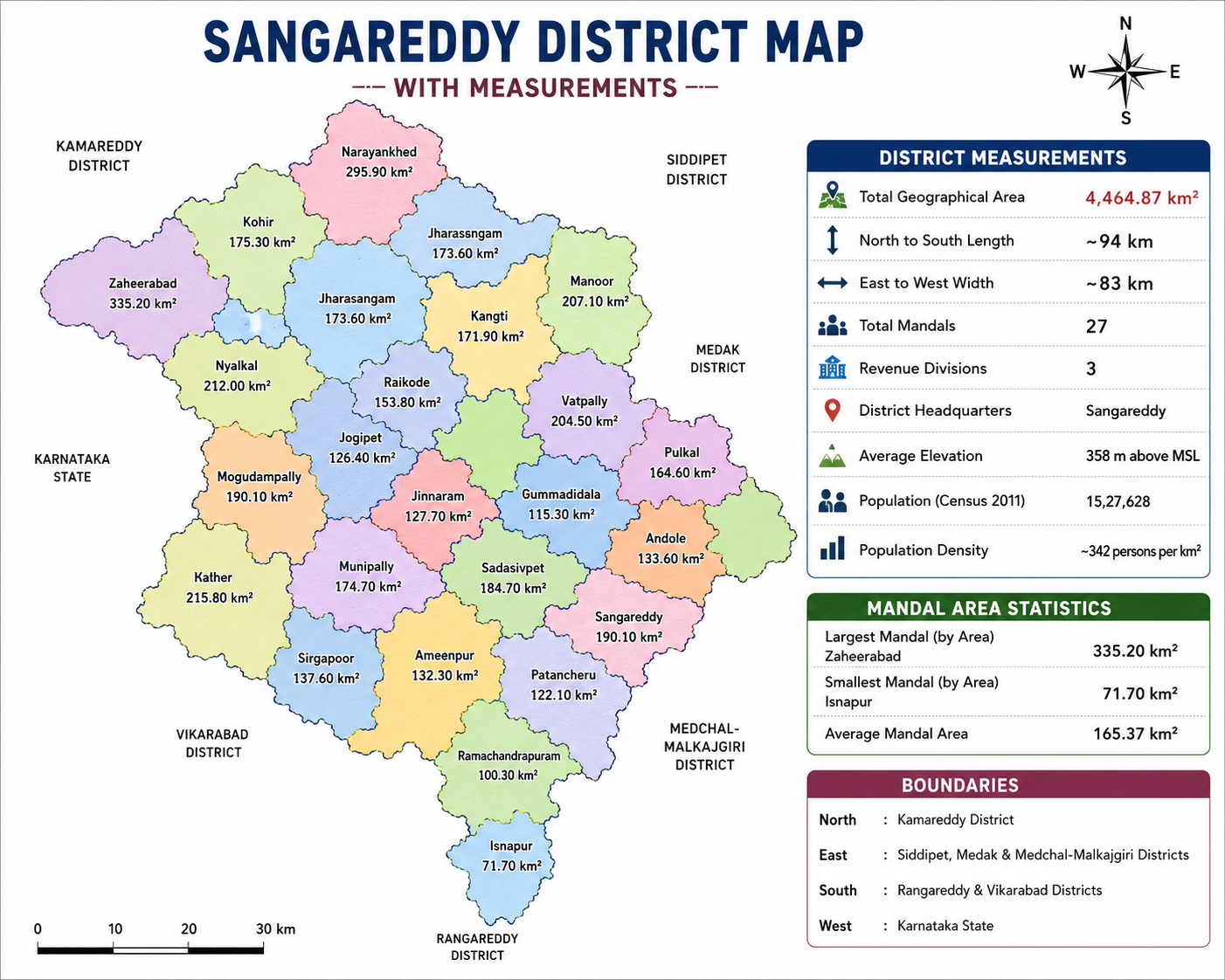
| Area | 4,464.87 sq. km |
| Population Density | ~342 persons per sq. km |
Sangareddy District Measurements
Previous History of Sangareddy District
Sangareddy District has a rich historical legacy that dates back several centuries. The region was once part of the ancient Kakatiya Kingdom, which ruled large parts of present-day Telangana and played a significant role in the development of irrigation, trade, and temple architecture. After the decline of the Kakatiyas, the area came under the control of the Bahmani Sultanate, followed by the Qutb Shahi rulers of Golconda. Later, after the fall of the Qutb Shahi dynasty, the region became part of the Mughal Empire and was subsequently incorporated into the dominions of the Asaf Jahi (Nizam) rulers of Hyderabad.
Historically, Sangareddy was known as Sangareddypeta. The town derives its name from Sanga, the son of Rani Shankaramba, the renowned ruler of Medak during the Nizam period. Rani Shankaramba was known for her administrative abilities and contributions to the development of the region. In honor of her son, the town came to be called Sangareddy, and over time the name became associated with the entire district.
After India’s Independence in 1947, the Hyderabad State was integrated into the Indian Union in 1948. Following the States Reorganisation Act of 1956, the region became part of the unified state of Andhra Pradesh. When the state of Telangana was formed on 2 June 2014, Sangareddy became part of the new state. Later, during the reorganization of districts, the Government of Telangana officially carved Sangareddy District out of the erstwhile Medak district on 11 October 2016 under G.O.Ms. No. 239, with Sangareddy serving as the district headquarters.
Today, Sangareddy is recognized as one of Telangana’s fastest-growing districts. While preserving its historical heritage, it has developed into a major center for industry, agriculture, education, healthcare, and infrastructure, making it an important contributor to the state’s economic and social development.
Revenue Administration of Sangareddy District
Sangareddy District has a well-organized revenue administration system that ensures effective governance, land administration, implementation of government welfare schemes, and public service delivery. The district is headed by the District Collector & District Magistrate, who supervises the overall administration through the Revenue Divisional Officers (RDOs), Tahsildars, and other revenue officials.
Revenue Divisions
According to the latest official information, Sangareddy District has 4 Revenue Divisions:
- Sangareddy
- Zaheerabad
- Narayankhed
- Andole–Jogipet
These divisions are administered by Revenue Divisional Officers (RDOs), who oversee revenue administration, land records, disaster management, and implementation of government programs within their respective jurisdictions.
Revenue Mandals
The district comprises 29 Revenue Mandals, each headed by a Tahsildar (Mandal Revenue Officer). The Tahsildar is responsible for:
- Maintenance of land records
- Issue of revenue certificates
- Collection of land revenue
- Mutation of land records
- Disaster relief administration
- Election-related duties
- Implementation of various government welfare schemes
Revenue Villages
Sangareddy District has 601 Revenue Villages, which serve as the basic administrative units for revenue management and rural governance. These villages are supported by Village Revenue Officers and other field-level officials who assist in land administration and public services.